
01
Congenital
Gaps in the eyelids, abnormal lid position, abnormal orbit shape or size, and blocked tear passages present from birth can be reconstructed.
Clear Vision. Expert Care. Healthier Eyes.
M G Eye Foundation/Services/Oculoplasty Services
Oculoplasty is plastic and reconstructive surgery of the eyelids, tear ducts and tissues around the eye. At M G Eye Foundation, Bara Gamharia, Jamshedpur, plans are individual: function first, then appearance. DR KUMAR SAKET and DR MALAY KUMAR DWIVEDI assess lid position, watering and orbital problems in this hospital.
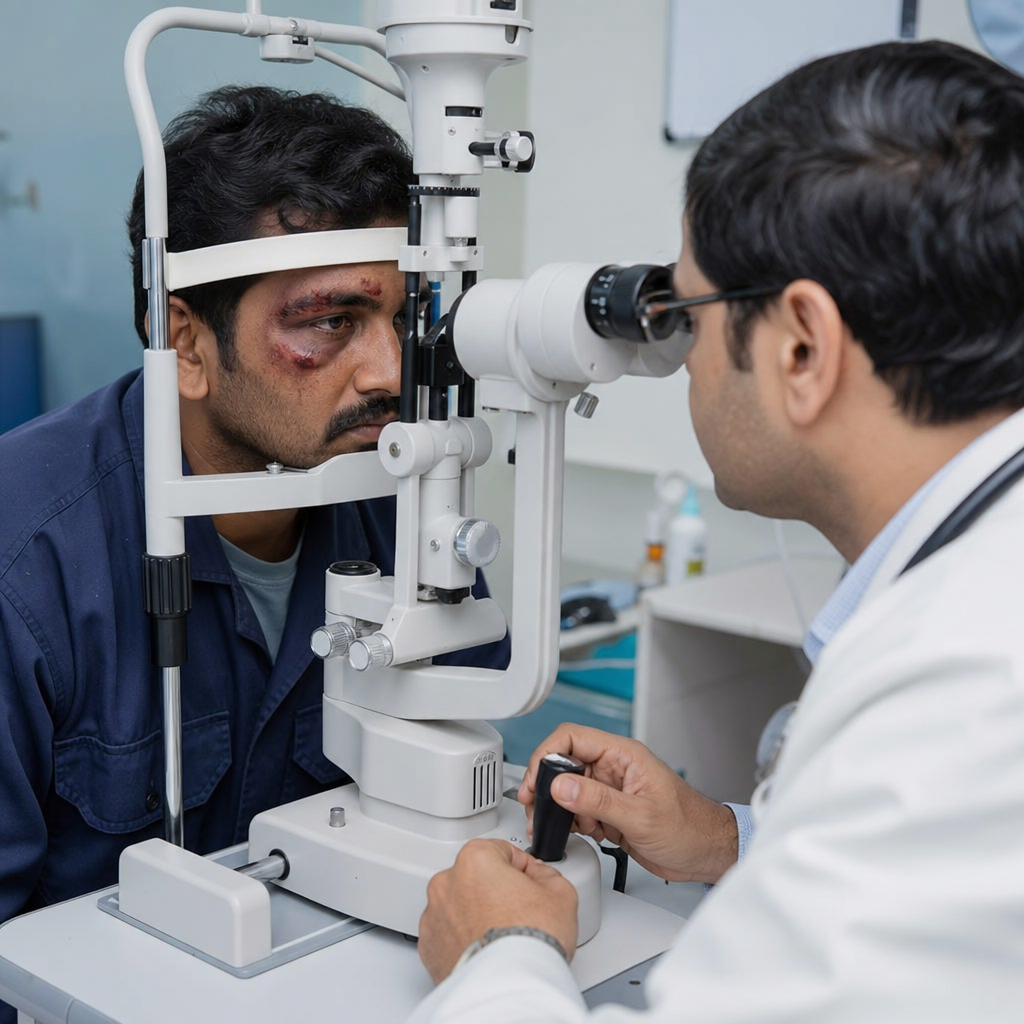
Oculoplasty covers operations on the eyelids and surrounding structures. Some procedures correct a structural problem so the eye is protected and tears drain. Others improve appearance after ageing, injury or tumour surgery. The aim is comfort, safety of the ocular surface, and a natural look.
When surgery is needed
Need is judged by function, infection risk and, where relevant, appearance after disease or injury.
Gaps in the eyelids, abnormal lid position, abnormal orbit shape or size, and blocked tear passages present from birth can be reconstructed.
Eyelid laceration, scar, orbito-facial fracture or loss of the eyeball can be repaired so the eye works better and looks more natural.
In-turning or out-turning lids, lashes rubbing the eye, droopy lids, bags and herniated orbital fat are common with age and can be corrected.
Cancers and other tumours of the lids and orbits are managed surgically. The priority is to protect life and vision, then reconstruct.
Watering with discharge and repeated infection can damage the eye and surrounding face. DCR (dacryocystorhinostomy) and DCT (dacryocystectomy) are the operations used.
Thyroid disease can swell the lids and orbits and threaten vision. If medicines are not enough, oculoplastic surgery is used to protect the eye.
How it feels
Watering, a lid that will not close, or a lump near the inner corner should be examined, not ignored.
01
Tears spill because the drainage path is blocked. Sticky discharge often means the sac is infected.
02
Lashes rub the cornea (entropion) or the lid hangs away (ectropion), causing redness and irritation.
03
Ptosis can cover the pupil, reduce the field of vision and force the brow to lift all day.
04
A cut or old scar may leave the eye exposed or the blink incomplete.
05
Fullness, pain or double vision can come from thyroid orbitopathy, fracture or a mass.
06
Not every lump is cancer, but lid tumours need examination and, when indicated, biopsy or excision.
After examination of the lids, tear pathway and orbit, surgery is tailored to the defect. Reconstructive work restores protection of the cornea and drainage of tears. Cosmetic work is discussed separately. Complex orbital disease may be planned with allied surgical specialties when the case requires it.
01
Dacryocystorhinostomy treats blocked tear ducts in adults by creating a new passage between the lacrimal sac and the nose, so tears drain past the blockage.
02
Dacryocystectomy removes the lacrimal sac when a new drainage passage is not appropriate, for example in selected infected or damaged sacs.
03
Eyelid reconstruction (including blepharoplasty when indicated) restores function and appearance of the lid and periocular area with as little extra morbidity as possible. Outcome depends on the defect, age, health of nearby tissue and surgical planning.
04
Orbital operations address tumours, thyroid-related orbital disease, fractures and congenital anomalies. Selected cases are planned with ENT, neurosurgery or maxillofacial colleagues so the approach is complete.
On-site equipment
Assesses lid margin, ocular surface and lacrimal puncta before surgery.
Provides magnification and illumination for delicate lid and lacrimal surgery.
Supports safe anaesthesia when the procedure cannot be done under local anaesthesia, including selected children.
Oculoplasty FAQs
Oculoplasty, or ophthalmic plastic surgery, concerns the eye and its surrounding structures. It is performed to improve function, comfort and appearance for tear-drainage problems, eyelid malposition, skin cancers of the eyelid, socket problems or brow problems.
Schemes typically cover reconstructive surgery that restores abnormalities caused by birth defect, trauma or disease, when the procedure restores function and a normal appearance. Surgery done only for cosmetic reasons is generally not covered. Confirm papers at the desk before admission.
Surgeons in this field operate on periorbital and facial tissues: eyelids, eyebrows, forehead, cheeks, the eye cavity and the tear system. Work includes tear-duct surgery, eyelid and brow lifts, thyroid eye disease, evisceration, enucleation and socket reconstruction.
Typical restrictions include:
For the first 48 hours use cold compresses to reduce bruising and swelling. Follow all post-operative instructions, rest the eyes, avoid heavy activity and protect the eyes from the sun.
Stitches may dissolve, or they are removed 7 to 15 days after surgery. Swelling and bruising of the lid can last 3 to 4 weeks.
to provide comprehensive eye care services to all the sections of society at affordable cost.
Doctors
DR KUMAR SAKET
Cataract, medical retina and trauma specialist
DR MALAY KUMAR DWIVEDI
Pediatric Ophthalmologist, Cataract and Squint specialist
Insurance and schemes
Bring your card and papers. The front desk will explain what is needed before admission.
Ayushman Bharat · PM-JAY
M G Eye Foundation is an empanelled facility under the PM-JAY scheme and welcomes patients seeking eye care under this programme. Kindly consult the front desk for further information prior to admission.
Jharkhand · SEHIS
M G Eye Foundation is associated with the Jharkhand Rajyakarmi Swasthya Bima Yojana (State Employees Health Insurance Scheme / SEHIS). State government employees, pensioners and eligible family members may seek eye care here under this programme. Kindly consult the front desk with your scheme card and papers prior to admission.