
01
Inheritance
Family history of squint or high spectacle power raises the chance that a child will need glasses or alignment surgery.
Clear Vision. Expert Care. Healthier Eyes.
M G Eye Foundation/Services/Pediatric Ophthalmology And Squint Services
Healthy eyes matter for a child’s learning and social development. At M G Eye Foundation, Bara Gamharia, Jamshedpur, DR MALAY KUMAR DWIVEDI, pediatric ophthalmologist, cataract and squint specialist, examines children according to age and developmental stage. DR KUMAR SAKET supports medical retina and trauma when those problems coexist.
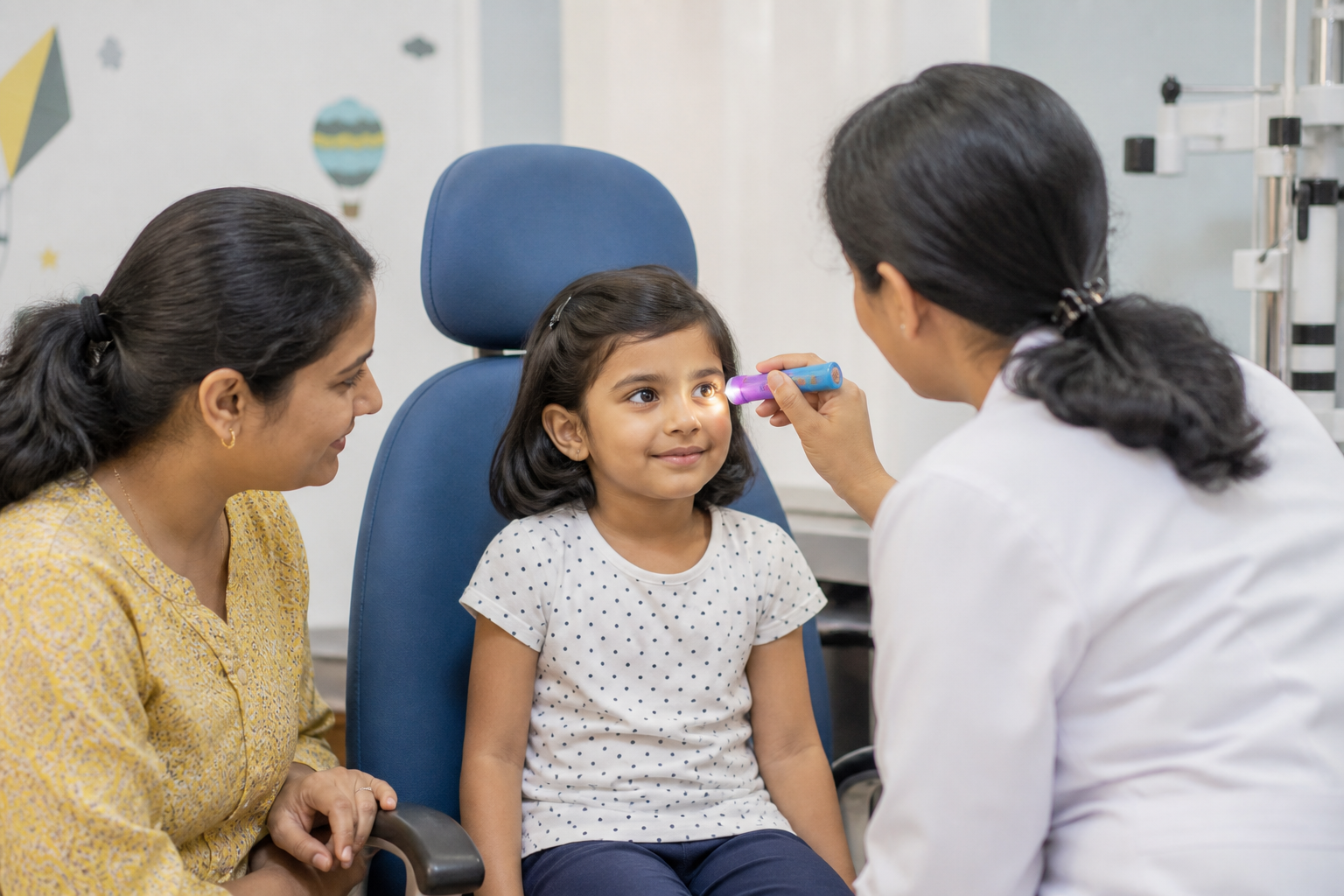
A child’s visual system is still developing. Uncorrected refractive error, cataract, squint or lazy eye can permanently limit vision if they are found late. Examinations, glasses and surgery are adapted to the child’s age, cooperation and the specific disease. We aim for a calm visit and a clear plan for the family.
Why it happens
Squint and pediatric cataract have several origins. Early examination still gives the best chance of useful vision.
Family history of squint or high spectacle power raises the chance that a child will need glasses or alignment surgery.
A cloudy lens present at birth or appearing in childhood blocks a clear image and can cause amblyopia if not treated in time.
Injury from a ball, stick, chemical or projectile can damage a child’s eye and needs prompt pediatric trauma care.
Down syndrome, cerebral palsy or a brain tumour can be associated with squint and reduced vision.
Babies born early or with low birth weight need ROP screening because retinal vessels may grow abnormally.
Myopia, hypermetropia and astigmatism in one or both eyes can lead to squint or amblyopia.
What parents notice
A child rarely describes blur well. Watch for an eye that turns, a white pupil, or difficulty reading.
01
One eye may look in, out, up or down. This is squint (strabismus) and should be examined even if it comes and goes.
02
Sitting close to the television, missing the board at school, or covering one eye are common clues.
03
Older children may report two images or skip lines when reading.
04
Clumsiness on stairs or in ball games can reflect reduced stereopsis.
05
Uncorrected power or a poorly controlled squint can cause brow ache after near work.
06
A white glow in photographs or roving eyes in a premature baby need urgent assessment, including for ROP or cataract.
Treatment is matched to the child: glasses, patching, contact lenses, Botox to selected muscles, or surgery for cataract, squint or trauma. ROP screening is timed for premature babies. Intraocular pressure and visual acuity are measured with child-friendly tools. General anaesthesia is available when a procedure cannot be done awake.
01
Cataract clouds the lens and causes blur, dull vision and glare. Surgery is planned for traumatic, congenital, developmental and secondary cataracts in children.
02
Misalignment (strabismus) means both eyes cannot look in the same direction at once. Surgery aims to align the eyes and improve related symptoms such as reduced vision, poor depth, double vision and reading difficulty.
03
Botulinum toxin injected into selected extraocular muscles temporarily weakens them so the eyes can realign. It is used for some forms of crossed or misaligned eyes.
04
Care for injury to a child’s eye, including chemical damage, blunt trauma from elbow, fist or ball, corneal burns or infection, and penetrating injury from a stick or projectile.
05
Retinopathy of prematurity affects retinal vessels in premature and low-birth-weight babies. Screening is typically done when the baby is four to six weeks old to look for abnormal vessel growth, abnormal eye movement or a white pupil.
06
Tono-Pen is a compact tonometer used to measure intraocular pressure when pediatric glaucoma is a concern. Lea symbols combine pictures and optotypes to measure acuity and help detect amblyopia.
07
The Titmus chart (housefly, animals and circle sets) measures stereopsis. The Luneau prism set is used to measure and follow squint in the clinic.
08
Lenses may be used in selected children for myopia, astigmatism, hyperopia, amblyopia, squint, aphakia after cataract, and other refractive needs.
On-site equipment
Comfortable pressure measurement without a large slit-lamp setup, useful in children.
Objective refraction and keratometry to support glasses and contact-lens planning.
Microscope for pediatric cataract, squint and trauma surgery.
Controlled anaesthesia when a child cannot cooperate for examination under anaesthesia or surgery.
Detailed view of the front of the eye when the child can sit for examination.
Pediatric FAQs
They diagnose and treat children’s vision problems and prescribe glasses and contact lenses when needed.
Glasses, injections, eye exercises and surgery can all play a role, chosen after examination.
Some children are born with a squint. Others develop it between 1 and 4 years of age.
Clues include an eye that turns, decreased vision, double vision, difficulty reading in older children, headache and poor depth perception.
When there are vision problems, a turning eye, a white pupil, premature birth needing ROP review, or a family history of serious childhood eye disease.
Children should have a first eye exam around six months of age and then at least once every year, or sooner if something looks wrong.
Strabismus, also called squint, is a condition in which the eyes are misaligned.
The main types are:
to provide comprehensive eye care services to all the sections of society at affordable cost.
Doctors
DR MALAY KUMAR DWIVEDI
Pediatric Ophthalmologist, Cataract and Squint specialist
DR KUMAR SAKET
Cataract, medical retina and trauma specialist
Insurance and schemes
Bring your card and papers. The front desk will explain what is needed before admission.
Ayushman Bharat · PM-JAY
M G Eye Foundation is an empanelled facility under the PM-JAY scheme and welcomes patients seeking eye care under this programme. Kindly consult the front desk for further information prior to admission.
Jharkhand · SEHIS
M G Eye Foundation is associated with the Jharkhand Rajyakarmi Swasthya Bima Yojana (State Employees Health Insurance Scheme / SEHIS). State government employees, pensioners and eligible family members may seek eye care here under this programme. Kindly consult the front desk with your scheme card and papers prior to admission.