
01
Myopia
Short-sightedness. Distant objects are blurred while near objects are clearer. The eye focuses light in front of the retina.
Clear Vision. Expert Care. Healthier Eyes.
M G Eye Foundation/Services/Refractive Error Service
Refractive errors are among the most common eye conditions. At M G Eye Foundation, Bara Gamharia, Jamshedpur, we measure how the eye focuses, prescribe spectacles or contact lenses, and counsel selected patients about LASIK, PRK or ICL after a full examination. DR KUMAR SAKET and DR MALAY KUMAR DWIVEDI explain what is suitable for your cornea and lifestyle.
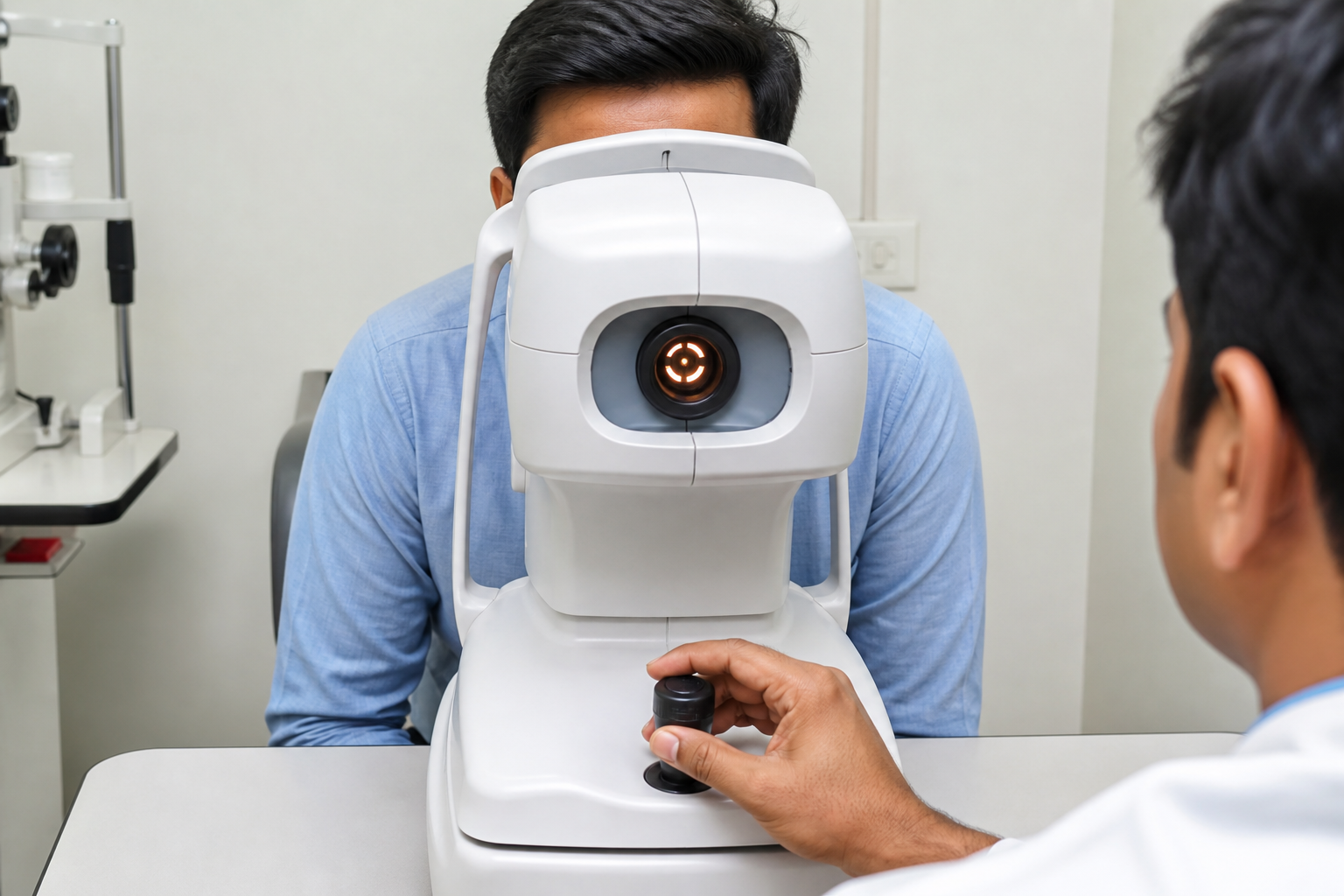
A refractive error occurs when the shape of the eye prevents light from focusing correctly on the retina. The image is then blurred. Most people can be helped with spectacles or contact lenses. Laser or an implantable lens is considered only after stability of power, corneal thickness and overall eye health are confirmed.
Types
More than one type can exist in the same eye. Measurement decides the prescription, not guesswork.
Short-sightedness. Distant objects are blurred while near objects are clearer. The eye focuses light in front of the retina.
Long-sightedness. Near objects may be hard to see clearly and the eyes may ache with prolonged reading.
The cornea or lens has an irregular curve, so vision is blurred or stretched at more than one distance.
An age-related fall in the eye’s ability to focus at near. It commonly becomes noticeable in middle age.
How it feels
Strain and squinting are common. Sudden change in power still needs a full eye check, not only new glasses.
01
Road signs, the classroom board, or a phone screen may be unclear depending on the type of error.
02
The focusing muscles work harder, especially with screens and small print.
03
Uncorrected hypermetropia or astigmatism often presents as brow ache in the evening.
04
Narrowing the lids is an attempt to sharpen a blurred retinal image.
05
Uncorrected astigmatism and high myopia can worsen halos and night driving.
06
Progressive myopia in the young, or shifting power in other disease, needs more than a simple refraction.
Most refractive errors are corrected with spectacles or contact lenses. For selected patients, refractive surgery or an implantable collamer lens may be considered after a detailed examination. Suitability depends on age, stability of power, corneal thickness and shape, and general eye health. No procedure can guarantee that glasses will never be needed again.
01
Laser-Assisted in Situ Keratomileusis reshapes the cornea so light focuses more accurately on the retina. It is used in suitable myopia, hypermetropia and astigmatism after a full work-up.
02
Photorefractive keratectomy also uses a laser to reshape the cornea but does not create a flap. It may be preferred when corneal thickness, shape or lifestyle make PRK the safer surface option.
03
An implantable collamer lens is placed inside the eye to correct refractive error. It is an option for selected patients, particularly when corneal laser is not suitable.
On-site equipment
Auto ref-keratometer for refractive power and corneal curvature — the starting point for glasses and surgical counselling.
Verifies the power and axis of existing spectacles so the new prescription can be compared accurately.
Checks the cornea, lens and ocular surface before any laser or implant is discussed.
Documents the front of the eye as part of the pre-operative assessment when surgery is considered.
Refractive FAQs
A vision problem caused when the eye does not focus light correctly on the retina. It can result in blurred or distorted vision.
Myopia, hypermetropia, astigmatism and presbyopia.
Yes. They are generally corrected with spectacles or contact lenses. Selected patients may also be suitable for laser refractive surgery or implantable lenses.
No. Suitability depends on age, refractive stability, corneal thickness and shape, eye health and other medical factors. A comprehensive examination is required.
Both use a laser to reshape the cornea. LASIK creates a corneal flap before treating the tissue beneath. PRK removes the surface epithelial layer and does not create a flap.
ICL is an implantable lens placed inside the eye. It can be considered for selected patients who are not ideal candidates for corneal laser procedures.
It can greatly reduce dependence on glasses or contact lenses in suitable patients, but it cannot guarantee that glasses will never be needed. Presbyopia can still affect near vision later in life.
to provide comprehensive eye care services to all the sections of society at affordable cost.
Doctors
DR KUMAR SAKET
Cataract, medical retina and trauma specialist
DR MALAY KUMAR DWIVEDI
Pediatric Ophthalmologist, Cataract and Squint specialist
Insurance and schemes
Bring your card and papers. The front desk will explain what is needed before admission.

Ayushman Bharat · PM-JAY
M G Eye Foundation is an empanelled facility under the PM-JAY scheme and welcomes patients seeking eye care under this programme. Kindly consult the front desk for further information prior to admission.
Jharkhand · SEHIS
M G Eye Foundation is associated with the Jharkhand Rajyakarmi Swasthya Bima Yojana (State Employees Health Insurance Scheme / SEHIS). State government employees, pensioners and eligible family members may seek eye care here under this programme. Kindly consult the front desk with your scheme card and papers prior to admission.